|
TRIPS l
ROUTES
l
HERITAGE l
BEACH
For those
who like trekking and nature, Roses has
five very well signposted and accessible
routes forming part of a unique natural
setting created by a perfect combination
of sea and mountains.
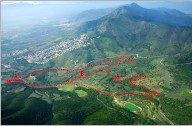
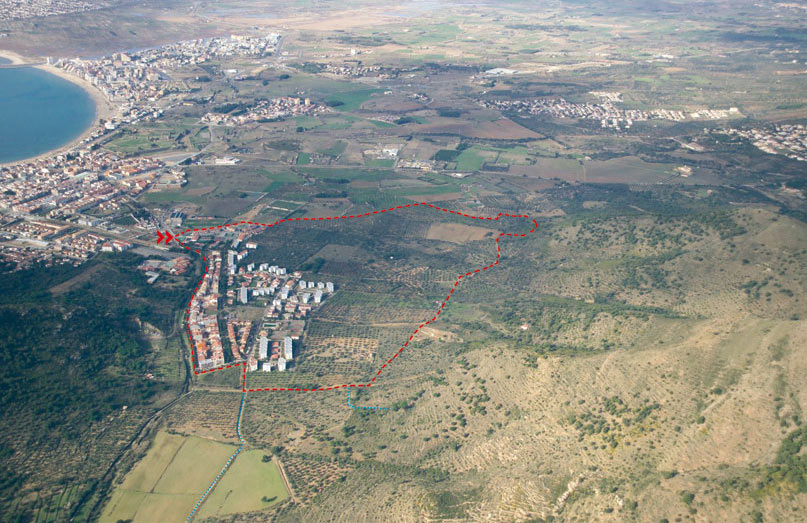
Route nš1
Discover
its prehistory
Duration:
3 hours (one way)
Distance:
3 kilometers
Itinerary:
Citadel Gate - Seafront Promenade - Carrer
Francesc Maciā - Carrer Pitāgores - Carrer
Homer (megalithic complex)
Optional visit:
cave-dolmen of the Rec de la Cuana
The tour of Roses' prehistoric remains is
within everyone's capabilities. The route
begins by climbing Carrer Francesc Maciā
street towards the Els Grecs residential
area, then continues up Carrer Pitāgores
as far as Carrer Homer, where the Hotel
Grecs stands (50'). Opposite the hotel we
take a path going uphill, and after 10
minutes we come to a fork. We take the
left fork and continue upwards; after
crossing Carrer Praxíteles, we find the
Cap de l'Home dolmen under two cork oaks.
Not far away, following the uphill path
and close to a monumental pine tree, there
is the dolmen of the Llit de la Generala,
erected around 3200 BC.
Following the path, which runs alongside a
stone wall, we reach a junction where we
take a track leading downhill to the
right. Following this, and a few metres to
the side of it, we find the first menhir
of the Casa Cremada, dated between the 4th
and 3rd millennia BC. Continuing down the
main path, after some 120 metres we find
nearby the remains of the late medieval
church of the Casa Cremada, which still
conserves a stretch of wall with slabs
arranged in the opus spicatum form.
Continuing on the signposted path, some
200 metres farther on we find the funeral
chamber of the Casa Cremada. Just 5
minutes farther along the path, there
stands the second menhir of the Casa
Cremada. 20 minutes along the final
straight of the same path, running along
the edges of a pinewood, we reach the
dolmen of the Creu d'en Cobertella, the
largest in Catalonia, declared a
historic-artistic monument in 1964. After
visiting the dolmen, we take the downward
path (6'), which leads us to the car park
by the Montjoi road. Before reaching this,
if we want to return to the town we can
take a path lined by a stone wall which
initially runs alongside the road, then
crosses it and finally goes down the hill
to reach the beginning of Carrer de la
Pedrera in 20 minutes; alternatively, we
can follow the road in the opposite
direction to reach the coves of Montjoi,
Pelosa or Jōncols.
Optional visit:
The best
way to reach the cave-dolmen of the Rec de
la Cuana is from the car park of the Creu
d'en Cobertella, walking towards the Pla
de les Gates. Taking the path furthest to
the right, which passes by the Rec de la
Cuana stream, and after 45 minutes of hard
climbing, we reach the cave-dolmen, dating
from 2500 BC, which was only discovered in
1998. It is a funerary monument whose
structure consists of a natural cavity, a
corridor of stone slabs and two walls.
Having seen the megalithic monument, we
can return downhill by the same path or
follow a marked path which climbs uphill
to reach a fork; the left-hand path leads
to the beginning of the itinerary.
-
Route nš2
-
-
Discover
its sea
- All
shades of blue
-
Duration: 1 hour 45 minutes (one
way)
-
Distance: 4 kilometers
- Itinerary: Citadel Gate -
Seafront Promenade - La Punta beach -
Port - Palangrers beach - La Poncella
point - Lighthouse - Canyelles Petites
beach - L'Almadrava beach.
-
-
Optional visit:
Trinity
Castle - Puig-Rom belvedere - Visigothic
fortress.
After the lighthouse of Roses, built in
1864 under Isabella II, we go down some
signposted steps leading to a marked
path lined by the sea and the rocks.
After 10 minutes' walk we reach the
Apartamentos Delfín, where we climb some
more steps to reach a street running
alongside the apartments. When we reach
the Apartaments L'Alguer, we go down
some more steps and rejoin the same path
as before, which leads to the cove of
Canyelles Petites, with its fine sand
beach and clean, clear water. At the
other end of the beach we climb more
steps and reach a path which runs along
the shore, passing by the Bonifaci cove;
two kilometers farther along the shore,
we reach L'Almadrava, an expanse of 450
meters of golden sand bathed by
turquoise waters.
Optional visit:
On the way back, after Canyelles, we go
up to the right via Carrer Antoni Canals.
At the first bend, 100 meters to the
right, stand the ruins of the Trinity
Castle. Following the same road to the top
of the hill, we reach the Puig-Rom
belvedere, where we can admire the most
fascinating panoramic views of the bay of
Roses. To the east of the belvedere lie
the remains of the Visigoth settlement, a
fortress built during the 7th C. for
defensive purposes.
-
Route nš3
-
-
Discover its promenade
- A
natural belvedere
-
Duration: 45 minutes (one way)
-
Distance: 2 kilometers
-
Itinerary: Citadel Gate - Seafront
Promenade - Santa Margarida beach
The attraction of this route along the
Promenade and breakwater lies in both the
walk itself and the constant view of the
bay. The route borders most of the beach
of Roses, then the beaches of Rastrell,
Salatar and Santa Margarida, finishing at
the breakwater. During the walk, in
addition to admiring the scenery, we can
enjoy the lively atmosphere of the
restaurants and terraces, which offer
views of the most spectacular sunsets of
the entire Catalan coast. The walk
finishes in Santa Margarida, a tourist
area with a marina and over sixteen
kilometers of navigable canals.
-
Route nš4
-
-
Discover its landscape
-
Following the shore walk
-
Duration: 4 hours (one way)
-
Distance: 19 kilometers
-
Itinerary: L' Almadrava beach -
Montjoi cove - Jōncols cove
The shore walk of Roses, which runs
within the Cap de Creus National Park,
forms part of the GR-92 and E-10 routes
and stretches from the point of
L'Almadrava to Jōncols cove, via the
Murtra, Rostella, Montjoi, Calitjās and
Pelosa coves, the peninsula of Cap Norfeu,
Canadell and Jōncols.The route begins at
the end of the Avinguda Díaz Pacheco, but
before reaching a small square with no
exit, we turn left up a signposted street
lined by several houses. At the last
chalet we take the downhill path leading
from the Falconera point beside the sea to
Jōncols cove. The shore walk allows us to
admire natural scenery dominated by an
intense blue, with cliffs, coves and small
inlets with clean, clear waters.
One of the most unusual places on the
coast road is cape Norfeu, a natural
reserve of the Cap de Creus Natural Park.
Norfeu is a peninsula which juts out a
kilometre and a half from the rest of the
coastline, elegantly forming what looks
like the outline of a sleeping rhinoceros.
It is situated between Pelosa and Canadell
coves. In mythology, Orpheus, god of
music, played his lyre here, and the
Pyrenean mountains drew so close to listen
to it that they lost their balance and
slipped to form the cliffs of cape Norfeu.
Amongst other features of interest along
the way are the Cova de les Ermites cave
(a cavern of geological interest), several
underwater caves, Norfeu tower (a
partially ruined lookout tower, used as a
reference point for fishermen and to scan
the coastline for pirate attacks), steps
cut into the rocks and leading down to the
sea (used formerly to take down baskets
laden with grapes), the Palaunencs hut
(used by farmers to shelter from the rain
and store their implements), and one of
the most amazing botanical gems, the
Astragalus massiliensis. At the foot of
the peninsula we find the curious El Gat
and Carall Bernat rocks, in addition to
many underwater caves, which North wind
and sea erosion have turned into features
with surrealist colors and shapes. El Gat
is a monolith which, as its Catalan name
suggests, is shaped like a cat, while
Carall Bernat is shaped like a rhinoceros
horn, on top of which an artificial nest
has been set in an Endeavour to encourage
the osprey to nest.
It would be a pity if visitors were to
leave Roses without having enjoyed this
rich natural heritage, either by walking
along the coastal path or by spending a
day underwater diving in one of the
Catalan coastline's most impressive and
spectacular diving zones
-
Route nš5
-
-
Discover its trees
- A
journey into monumental vegetation
-
Duration: 1 hour 30 minutes (one
way)
Distance: 3 kilometers
Itinerary: Citadel Gate - Carrer
Madrid - Plaįa Pep Ventura - Carretera
del Mas Oliva - Carrer Oslo - Carrer
Brusel·les - Carrer Amsterdam - Large
Pine - Millenary Olive Tree.
The route which allows us to discover
the monumental trees of Roses begins in
the Mas Oliva residential area. We begin
by walking up Carrer Oslo, then up Carrer
Brusel·les, and cross Carrer Viena to
reach Carrer Amsterdam. Here we turn right
and continue along a track which after
some 90 meters reaches a fork. If we take
the path to the left, after 30 minutes we
reach the Large Pine, the biggest in
Catalonia, with a trunk so wide that it
cannot be encircled by three men holding
hands. If we continue straight on at the
fork, towards the Mas de l'Alseda
farmhouse, in less than 25 minutes we
reach the splendid Millenary Olive Tree,
which over the centuries has become a
symbol of the town. |